Da Lat, Vietnam: Where Misty Mountains, Coffee and Flowers Change the Rhythm of Travel
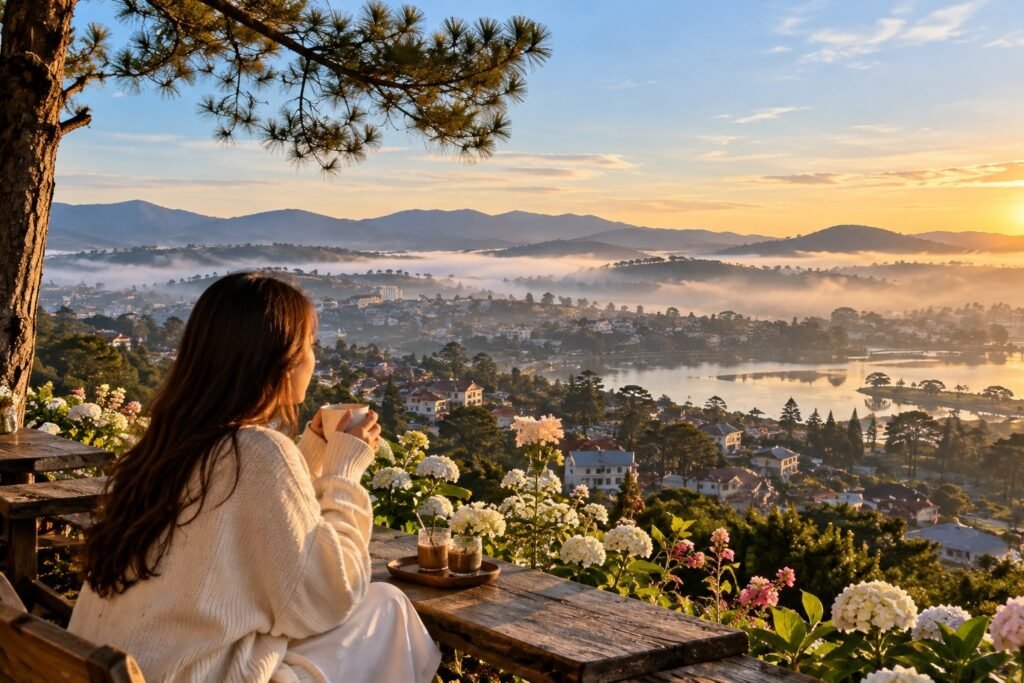
Da Lat, Vietnam
Vietnam is often associated with tropical heat, busy streets, beaches, rice fields and cities that seem to move at full speed from morning until night. Then there is Da Lat.
High in Vietnam’s Central Highlands, Da Lat feels almost like a pause button.
The air is cooler. Pine trees replace coconut palms. Early mornings arrive wrapped in mist, cafés look out over green valleys, and entire hillsides disappear beneath flower farms and glasshouses. At night, you may even find yourself reaching for a sweater — a surprisingly unusual feeling if you have just travelled north from the tropical coast.
Da Lat is frequently called Vietnam’s City of Flowers, but flowers are only one part of what makes the place memorable.
What really sets Da Lat apart is its atmosphere.
It is romantic without trying too hard, lively without being exhausting and beautiful in a way that slowly reveals itself rather than demanding attention immediately.
For travellers who enjoy places that invite them to stay rather than rush through a checklist, Da Lat can become one of Vietnam’s most unexpected highlights.
A Different Side of Vietnam
The first thing many visitors notice is the temperature.
Da Lat sits at around 1,500 metres above sea level, giving it a much milder climate than many destinations in southern Vietnam. Days can be pleasantly warm, while mornings and evenings often feel noticeably cooler.
That climate has shaped almost everything around the city.
Pine forests surround Da Lat. Farms spread across the hills. Strawberries, vegetables, coffee and flowers thrive in the surrounding countryside. In the early morning, valleys may fill with mist before gradually revealing greenhouses, rooftops and distant mountains.
It can feel surprisingly far removed from the image many travellers have of Vietnam.
And yet Da Lat remains unmistakably Vietnamese.
Motorbikes weave through the streets. Strong coffee is served with condensed milk. Street vendors prepare snacks late into the evening, and local markets are filled with fresh produce, flowers and conversation.
The magic is in that contrast.
Start Slowly
Da Lat is not a city that needs to be conquered.
In fact, rushing through it may be the quickest way to miss what makes it special.
A good day can begin with something as simple as coffee.
Vietnam’s Central Highlands are one of the country’s most important coffee-growing regions, and Da Lat has developed a café culture that feels particularly suited to the landscape.
Some cafés are hidden down small streets. Others sit on hills overlooking valleys, forests or rows of greenhouses.
Order a Vietnamese coffee, find a place outside and stay longer than you intended.
That is part of the experience.
There is something about cool mountain air and strong Vietnamese coffee that makes doing very little feel like a perfectly reasonable travel plan.
Xuan Huong Lake and the Heart of the City
At the centre of Da Lat lies Xuan Huong Lake.
It is not the kind of attraction that demands a special excursion, and that is precisely why it works so well.
The lake feels woven into daily life.
People walk along the shore in the morning, couples sit together in the evening, cyclists pass by, and the city seems to organize itself around the water.
It is an easy place to begin exploring Da Lat on foot.
From here, you can gradually move toward cafés, markets, shops and some of the city’s better-known landmarks without feeling as though you are following a rigid tourist route.
The best time may be early morning, when the air is cooler and the city has not fully woken up yet.
Later, the area becomes more animated and offers an entirely different atmosphere.
Why Da Lat Is Called the City of Flowers
Flowers are everywhere in Da Lat.
Not just in formal gardens or tourist attractions, but in ordinary life.
They appear outside cafés, in hotel lobbies, on balconies, at markets and in small florist studios scattered around the city.
The surrounding region has a climate particularly well suited to flower cultivation. Roses, chrysanthemums, hydrangeas, gerberas, lilies and many other varieties are grown around Da Lat.
Drive beyond the city centre and you begin to understand the scale of the industry.
Large greenhouses cover sections of the hills, sometimes stretching so far that they appear to form part of the landscape itself.
But the interesting part is not simply how many flowers are grown here.
It is how naturally they have become part of the identity of the city.
A bouquet in Da Lat somehow feels different from a bouquet bought in an anonymous city shopping centre.
You know the flowers may have been grown only a short distance away.
You see florists working with them every day, creating arrangements that range from traditional romantic bouquets to loose, colourful compositions that almost look as though they were gathered from a meadow.
Local studios such as Sisters Flowers Da Lat reflect this softer, more contemporary side of the city’s flower culture — using colour, seasonal flowers and natural shapes rather than making every bouquet feel identical.
In Da Lat, flowers are not simply a souvenir.
They are part of the place.
The Countryside Begins Almost Immediately
One of Da Lat’s greatest advantages is how quickly you can leave the urban streets behind.
Travel only a short distance and the scenery changes.
Pine forests appear. Farms begin to dominate the hillsides. Small roads wind through valleys and villages.
This makes Da Lat an excellent base for travellers who enjoy day trips and nature.
Tuyen Lam Lake
Tuyen Lam Lake is one of the easiest places to escape the city.
Surrounded by forested hills, it feels considerably calmer than the urban centre.
The area is popular for quiet walks, scenic viewpoints and simply enjoying the landscape.
Nearby, Truc Lam Zen Monastery adds another reason to visit.
Even travellers without a particular interest in Buddhism may appreciate the peaceful gardens, architecture and atmosphere.
The combination of forest, lake and temple makes this one of the places where Da Lat’s slower personality is easiest to understand.
Waterfalls and Mountain Roads
The landscape around Da Lat is shaped by hills, rivers and waterfalls.
Datanla Waterfall is among the most accessible and well-known examples.
The area is more developed than some remote waterfalls, but it is convenient for travellers who want to combine nature with other activities.
Beyond the main attractions, however, simply driving through the countryside can be equally rewarding.
Mountain roads pass farms, coffee plantations, flower greenhouses and small communities.
This is one of those destinations where getting from one place to another can become part of the experience.
If you are comfortable riding a scooter and have experience with Vietnamese traffic, exploring independently can give you considerable freedom. Otherwise, hiring a driver for the day can be a much more relaxing option.
A Hint of Europe in the Highlands
Da Lat also has an unusual architectural history.
During the French colonial era, its cool climate made it attractive as a mountain retreat, and European influences can still be seen around the city.
Old villas, churches and public buildings sometimes create unexpected visual moments among the Vietnamese streets and pine-covered hills.
The historic Da Lat Railway Station is one of the most recognizable examples.
Its architecture feels distinctly different from what travellers may have seen elsewhere in Vietnam.
Yet the city never feels like a European town transplanted into Asia.
The influences have blended into something unique.
A French-style villa may stand near a Vietnamese market. A café with vintage décor may sit a few minutes from a busy street full of scooters.
Da Lat works precisely because of those contradictions.
The Night Market: Da Lat After Dark
When evening arrives, the centre of Da Lat changes.
The night market becomes one of the city’s busiest gathering places.
Food stalls appear, groups of young people fill the streets and the smell of grilled food mixes with the cool evening air.
This is the moment to forget about carefully planned restaurant reservations and simply wander.
Try grilled corn.
Look for sweet potatoes.
Drink hot soy milk.
Sample whatever catches your attention.
Da Lat is also known for strawberries, and they appear everywhere — fresh, dried, turned into jams or incorporated into desserts.
The cooler evening weather makes hot street food unusually satisfying.
After spending the day exploring lakes, temples and gardens, the night market provides a completely different side of the city.
Da Lat Is Romantic — But Not Only for Couples
Within Vietnam, Da Lat has a strong reputation as a romantic destination.
It is easy to see why.
Misty mornings, flower gardens, lakes, forests and cooler evenings create an atmosphere that naturally suits couples.
People come for honeymoons, anniversaries, wedding photography and proposals.
Hotels and local businesses have adapted to this audience too. It is easy to arrange romantic dinners, flowers or small surprises delivered directly to a hotel.
But Da Lat should not be reduced to a couples’ destination.
Solo travellers may enjoy the city even more precisely because it is easy to slow down here.
Photographers have endless subjects.
Food lovers have markets and cafés.
Nature travellers have the surrounding countryside.
And anyone who has spent too long in large cities may simply appreciate the feeling of breathing cooler mountain air.
How Long Should You Stay in Da Lat?
Two nights will give you an introduction.
Three or four nights are much better.
Da Lat works best when you leave some empty space in the itinerary.
One day could be devoted to the city centre, Xuan Huong Lake, markets and cafés.
Another could take you toward Tuyen Lam Lake, the monastery and nearby nature.
A third can be used to explore farms, waterfalls and the countryside.
And one morning should probably be left completely unplanned.
Find a café with a view.
Order coffee.
Watch the mist disappear from the hills.
Sometimes that will become the memory that lasts longest.
What Da Lat Really Feels Like
Travel guides naturally focus on attractions.
But Da Lat is one of those destinations where the small moments may matter more.
It is the feeling of cold air when you step outside early in the morning.
The smell of coffee.
A scooter passing with an enormous bundle of flowers tied to the back.
Hydrangeas growing beside a road.
A florist carefully arranging roses behind the window of a small shop.
A bowl of hot food at the night market when the temperature drops after sunset.
The sound of rain against a café window.
Mist floating between pine-covered hills.
None of these experiences alone would justify travelling across the world.
Together, they explain why people fall in love with Da Lat.
One Place, Two Stories
There are really two Da Lats.
The first is the Da Lat travellers see: flowers, cafés, waterfalls, lakes, colourful markets and romantic viewpoints.
The second is the Da Lat that exists behind those images.
It is a working agricultural region where people grow flowers, coffee, vegetables and fruit. It is a city where florists begin preparing orders early in the morning, farmers work in greenhouses covering the hills, and café owners serve beans grown in the surrounding highlands.
Seeing both sides makes the destination more interesting.
The flowers look more beautiful once you understand where they come from.
The coffee tastes different once you have driven through the farms.
And the hills become more than a pretty background when you realize how deeply they shape life here.
That is perhaps the real reason to visit Da Lat.
Not because it offers the biggest monument, the most famous beach or the busiest nightlife in Vietnam.
But because it shows an entirely different version of the country.
A cooler, greener, quieter Vietnam where mountains replace tropical coastlines, coffee grows on the hills and flowers are part of ordinary life.
And once you settle into its rhythm, you may understand why leaving after only a couple of days can suddenly feel much too soon.